I am working on a project applying a post-processed dust model to TNG300 to understand dust in large-scale structure. Obviously there are a ton of challenges with this (in particular unresolved cool clouds in CGM), but below is a figure showing dust mass in a slice of the TNG300 volume at z=0. This poster contains details on currently very simple dust model. One thing that struck me is just how little dust is in the voids. To save compute time, I assume zero dust in gas cells which are at/below the initial/primordial gas metallicity in TNG (8e-10, according to Pakmor et al. 2022).
It seems most of the gas within voids remains unenriched even at z=0. In reality, of course, sub-resolution turbulent processes could carry more metals/dust into the voids than is resolvable in TNG300, but still, this is quite surprising to me.
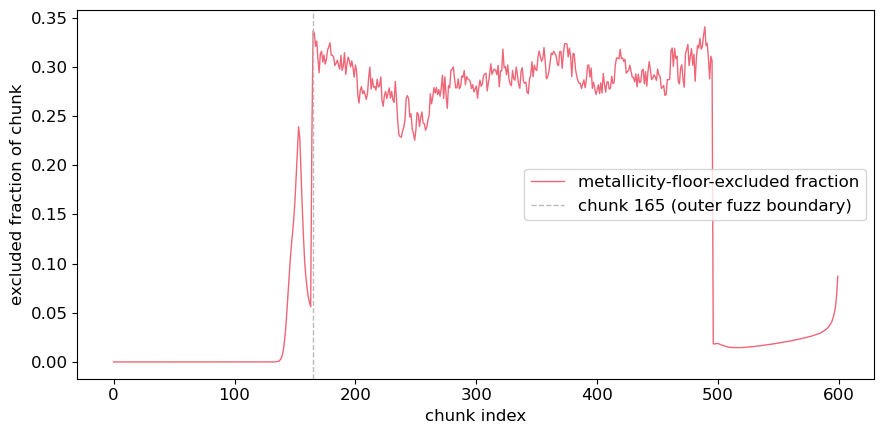
In imposing the primordial metallicity filter, something came up that I am unable to explain. This plot shows the fraction of gas cells in a given z=0 snapshot chunk which are being excluded from the analysis because their metallicity is less than the primordial metallicity. I've drawn a dashed line at chunk 165, which is where I've found the 'outer fuzz' gas cells begin in this snapshot. I assume the increase before chunk 165 is due to those chunks being biased toward galaxies in underdense regions (i.e., void galaxies), which have been shown to be less metal-enriched, so I can somewhat understand what I see there. What I find very confusing is the dramatic drop at around chunk 500. Do you know why those chunks would contain gas particles that are more metal-enriched than other outer fuzz chunks? The website explains how particles are ordered within groups and subhalos, but not much about how the outer fuzz particles are ordered.
I appreciate your help and the available TNG resources. I'll be happy to share my computed dust masses with the TNG community once I've implemented planned improvements to the dust model and published.
Thanks!
Dylan Nelson
6 Aug
The sort is: group number, subhalo number, then binding energy. Perhaps this last segment therefore represents an ordering of binding energy, for gas cells in outer fuzz. A picture might help show if this is e.g. correlated with distance to the nearest massive halo(s).
Hello Dylan,
I am working on a project applying a post-processed dust model to TNG300 to understand dust in large-scale structure. Obviously there are a ton of challenges with this (in particular unresolved cool clouds in CGM), but below is a figure showing dust mass in a slice of the TNG300 volume at z=0. This poster contains details on currently very simple dust model. One thing that struck me is just how little dust is in the voids. To save compute time, I assume zero dust in gas cells which are at/below the initial/primordial gas metallicity in TNG (8e-10, according to Pakmor et al. 2022).
It seems most of the gas within voids remains unenriched even at z=0. In reality, of course, sub-resolution turbulent processes could carry more metals/dust into the voids than is resolvable in TNG300, but still, this is quite surprising to me.
In imposing the primordial metallicity filter, something came up that I am unable to explain. This plot shows the fraction of gas cells in a given z=0 snapshot chunk which are being excluded from the analysis because their metallicity is less than the primordial metallicity. I've drawn a dashed line at chunk 165, which is where I've found the 'outer fuzz' gas cells begin in this snapshot. I assume the increase before chunk 165 is due to those chunks being biased toward galaxies in underdense regions (i.e., void galaxies), which have been shown to be less metal-enriched, so I can somewhat understand what I see there. What I find very confusing is the dramatic drop at around chunk 500. Do you know why those chunks would contain gas particles that are more metal-enriched than other outer fuzz chunks? The website explains how particles are ordered within groups and subhalos, but not much about how the outer fuzz particles are ordered.
I appreciate your help and the available TNG resources. I'll be happy to share my computed dust masses with the TNG community once I've implemented planned improvements to the dust model and published.
Thanks!
The sort is: group number, subhalo number, then binding energy. Perhaps this last segment therefore represents an ordering of binding energy, for gas cells in outer fuzz. A picture might help show if this is e.g. correlated with distance to the nearest massive halo(s).